
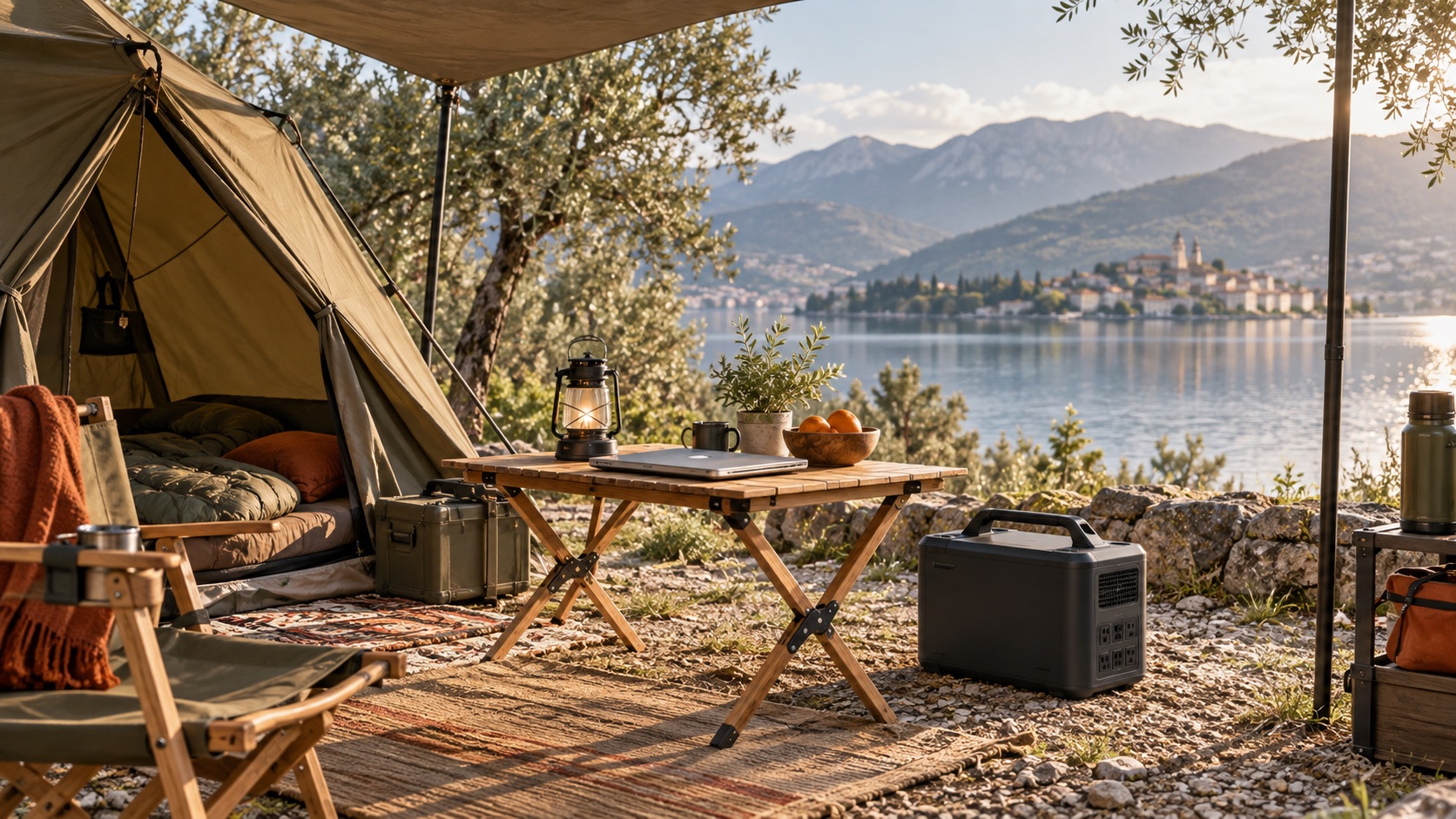
Your limiting factor is often the energy you need before the next reliable recharge, followed by what you can carry to the pitch.
What we would choose
| Your priority | Start with | Our advice |
|---|---|---|
| A light carry for short sessions | BLUETTI Elite 30 V2 | Choose it for 600 W output at 4.3 kg; its 288 Wh battery needs a modest load and a recharge plan. |
| A 512 Wh setup | Jackery Explorer 500 v2 | Our lighter choice at 5.7 kg. The 6 kg RIVER 2 Max is the alternative if USB-C recharging matters. |
| More energy between charges | Jackery Explorer 1000 v2 | Our 1 kWh starting point for regular carrying: 1,070 Wh at 10.8 kg, with a 1,500 W limit. |
The linked profiles explain the choices and show their sources.
Plan the trip
Read the full camping energy budget, then check solar compatibility. The energy planner shows how your assumptions change the required nominal capacity.
If two models look similar
Our Jackery 1000 v2 versus BLUETTI Elite 100 V2 comparison explains the weight/output trade-off.
An example load budget
These are invented planning inputs to show the arithmetic, not measured appliance consumption. Replace them with your own equipment readings.
| Example load | Average W | Hours | Energy Wh |
|---|---|---|---|
| LED lights | 8 | 4 | 32 |
| Laptop | 45 | 2 | 90 |
| Charging small devices | 15 | 2 | 30 |
| Example delivered energy | 152 Wh | ||
Nominal capacity must also cover conversion losses and the reserve you choose. Use the planner to change those assumptions. Add running watts only for loads used at the same time; assess startup separately.
Prepare your setup
Start with what the station can run and for how long, then check power-saving and charging settings before relying on it away from home.
Compare more brands for camping
For a station you will carry regularly, compare the smaller models in our PECRON and VTOMAN coverage. For vehicle-based trips with a larger energy budget, compare the 1 kWh and 2 kWh choices from OUKITEL and FOSSiBOT. Each brand page explains the capacity and carrying trade-off; the model records retain regional buying gaps.
Use your equipment’s daily energy total to choose capacity, and its simultaneous power demand to choose output. Include the time between charging stops and the distance you will carry the station.