
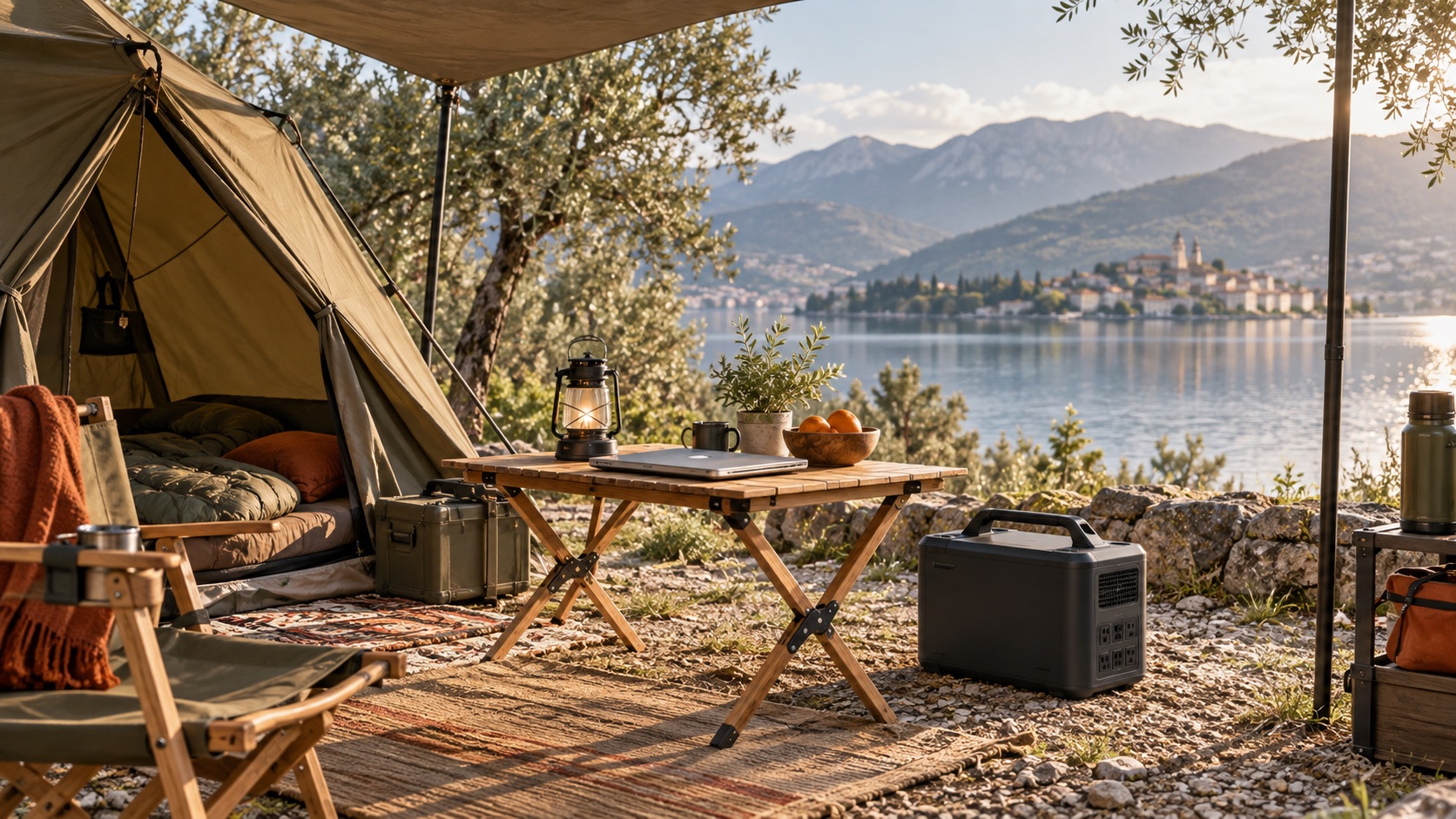
The most useful camping power station is one you can carry to the pitch and recharge before it runs flat. Start with those two questions before comparing the biggest number on the box.
A weekend spent charging phones and running small lights is a different job from keeping a fridge running. A kettle or electric hob introduces another constraint: high output, even when used briefly. A station can have enough stored energy for your trip and still be unable to run your chosen appliance.
Write down the electrical jobs
List each device, its power requirement and how long you expect to use it. Use the device manual or a suitable measurement of your own equipment. A charger's maximum rating is not necessarily its continuous consumption.
For an illustration, imagine this daily allowance. These are invented planning inputs, not measured consumption figures for particular devices:
| Job | Assumption | Daily energy |
|---|---|---|
| Two phone charges | 15 Wh delivered to each | 30 Wh |
| Small lighting setup | 5 W for 4 hours | 20 Wh |
| Laptop work | 40 W average for 2 hours | 80 Wh |
| Total | Before charging/conversion losses | 130 Wh |
Two days would require 260 Wh delivered to those loads. That does not make a nominal 260 Wh battery sufficient: conversion losses, the station's own consumption and unused reserve must also be accounted for. We have not measured usable capacity ourselves, so this example establishes a starting energy budget rather than a product recommendation.
A fridge needs its own allowance. Its consumption changes as its compressor cycles and with temperature, contents and settings. Do not multiply a peak compressor rating by every hour of the trip and call it a measured daily requirement.
Check output separately from capacity
Capacity in watt-hours describes stored energy. Output in watts describes a power limit. Check continuous output and any relevant startup demand; a marketing “boost” mode is not a substitute for compatible voltage and continuous output.
The same distinction matters on a powered campsite. The Camping and Caravanning Club advises campers to account for the supply limit and the appliances running together. Ask the campsite what is available on your pitch before assuming you can recharge a station at its fastest setting. Club guidance on campsite electricity.
Decide how it gets recharged
A solar input rating is an electrical limit, not an assurance of that much charging throughout the day. Check the exact station's voltage, current and connector requirements against the panel. Consider where it can sit while you are away from the pitch, and what your plan is if sunshine is limited.
Car charging deserves the same attention. An accessory socket, a purpose-built alternator charger and a vehicle's AC outlet are different charging routes with different requirements. Check the manual and the vehicle's instructions rather than treating every advertised car-charging figure as available in your car.
Carrying and weather can settle the choice
Include the panel, cables and any expansion battery in the load you will transport. A station that is manageable from car to kitchen may be awkward across a muddy campsite. Check handle arrangement, dimensions and your own lifting limit as well as kilograms.
Keep equipment within its documented operating conditions. A rugged-looking case is not evidence of rain protection. The Club's tent-electricity advice also highlights damp conditions and suitable equipment; a portable station does not make the rest of the electrical setup weatherproof. Using electricity in a tent.
Start your shortlist with the weight and capacity filters, then compare the exact regional versions. If phones and lights are the entire requirement, a small USB power bank may be enough. A larger station earns its place when the extra sockets or stored energy solve a job you actually have.