
Can it power my equipment?
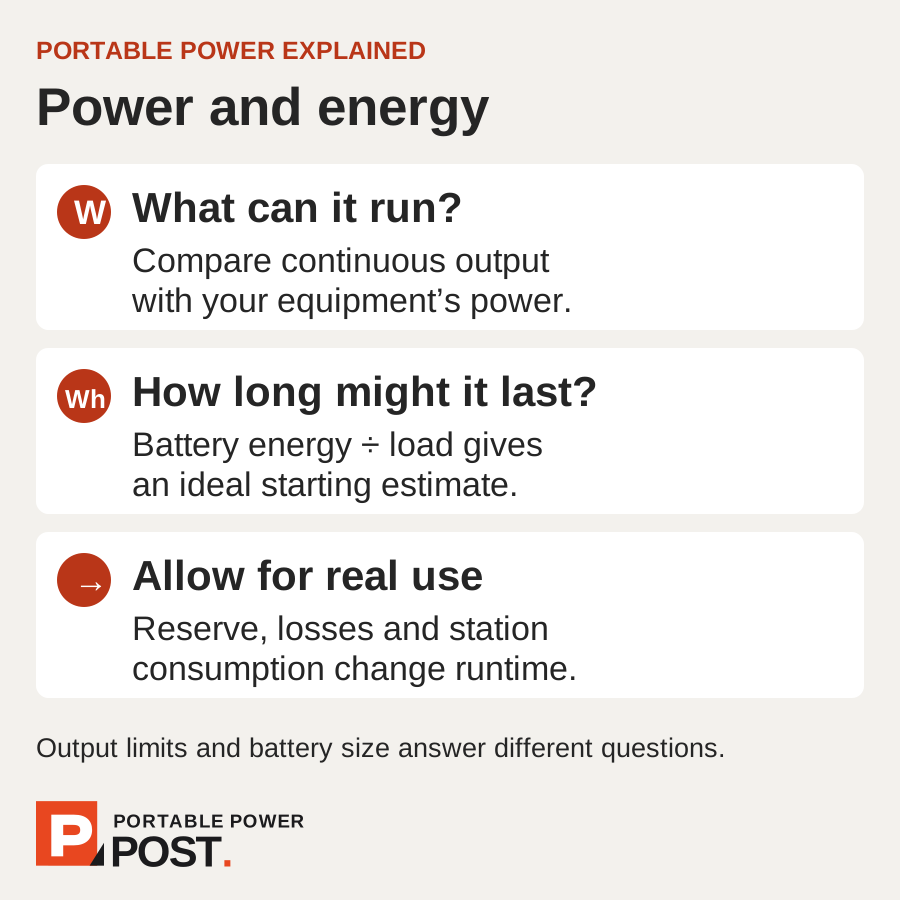
Add the watts used by devices that will run together, then compare that total with the exact regional model’s documented continuous output. Check each appliance’s startup requirement separately. An advertised boost or short surge figure is not a replacement for a continuous rating.
A 2,000 W appliance exceeds a 1,500 W continuous output. A bigger battery does not remove that output limit. Conversely, a low-power device may fit the output limit but still need a larger battery to run all night.
What is the difference between watts and watt-hours?
Watts (W) describe power at a moment in time. Watt-hours (Wh) describe energy: a steady 100 W load uses 100 Wh in one hour. Nominal battery capacity is not the energy guaranteed to reach your appliance.
How do I estimate runtime?
Dividing nominal Wh by load W gives an idealised starting point. Then account for reserve, conversion losses and the station’s own consumption. Our energy planner uses a delivered-energy share and reserve; it does not explicitly model a fixed wattage used by the station.
Why can a small load run for less time than expected?
The station needs energy to operate its electronics and inverter. That matters more when the appliance itself draws little power. BLUETTI’s Elite 100 V2 manual gives approximately 10 W for the station’s own consumption and a runtime formula that adds this to the load.
For a constant 20 W load and this model’s nominal 1,024 Wh capacity, compare these illustrations, not measured runtimes:
- Ideal arithmetic: 1,024 ÷ 20 = 51.2 hours, ignoring every loss.
- Planner example at 80% delivered energy and 10% reserve: 1,024 × 0.80 × 0.90 ÷ 20 = 36.9 hours. The combined allowance is 72% of nominal energy.
- Manual-style example: 1,024 × 0.90 × 0.90 ÷ (20 + 10) = 27.6 hours. This uses the manual’s 90% depth of discharge and a 90% efficiency illustration; the manual states efficiency above 90%, without establishing it for this particular load.
These models use different assumptions. The 27.6-hour figure is not a correction proven by testing. Do not subtract another 10 W blindly from a planner estimate whose delivered-energy allowance already includes operating losses. At a 100 W load the same examples give about 7.4 and 7.5 hours, showing why the assumption matters especially at low loads.
Could power-saving mode switch my device off?
Yes, depending on the model and setting. BLUETTI advises disabling ECO for small loads under 60 W or appliances that need uninterrupted output. Its manual does not establish a universal shutdown threshold for other stations. Read our settings checklist before relying on a router or light overnight.
What should I check before relying on the estimate?
Use your appliance’s actual power requirement where available, account for cycling loads, confirm the output and startup limits, and try the complete setup beforehand. Temperature, battery condition, ports and charging conditions change the result. A planning estimate does not establish suitability for life-critical equipment or household wiring.