
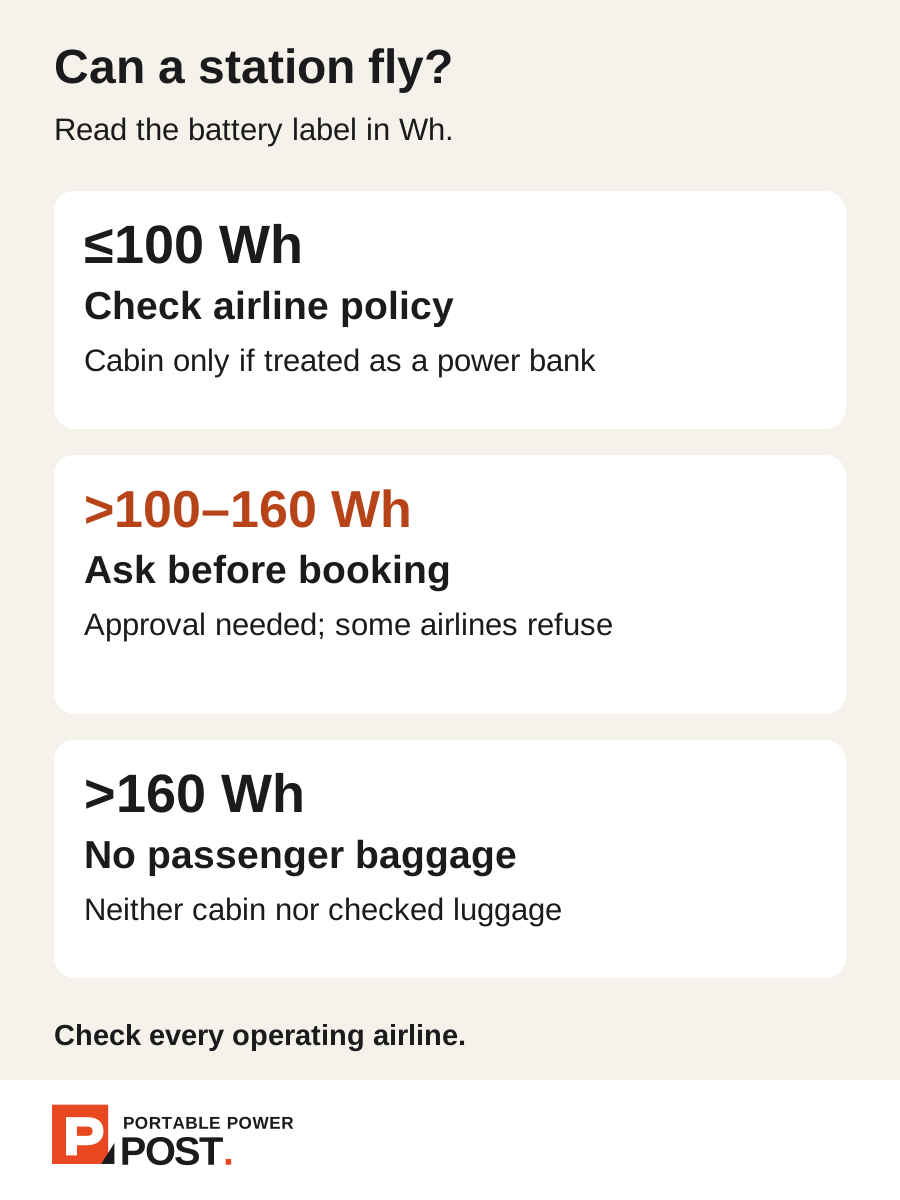
Above 160 watt-hours (Wh), leave a portable power station out of both cabin and checked luggage. At over 100 Wh to 160 Wh, ask the operating airline before you travel; it may refuse. Even at 100 Wh or below, check the airline’s current policy and how it classifies your exact unit.
A portable power station may look like a large power bank with an AC socket, but its battery capacity decides whether it is even a candidate for passenger baggage. These examples concern ordinary rechargeable lithium battery stations, not medical mobility aids, which have separate rules. We have not sought airline approval for any model. Rules and airline policies were checked on 24 October 2026; recheck them for every flight, including connections and codeshares.
Find the right number: Wh, not W
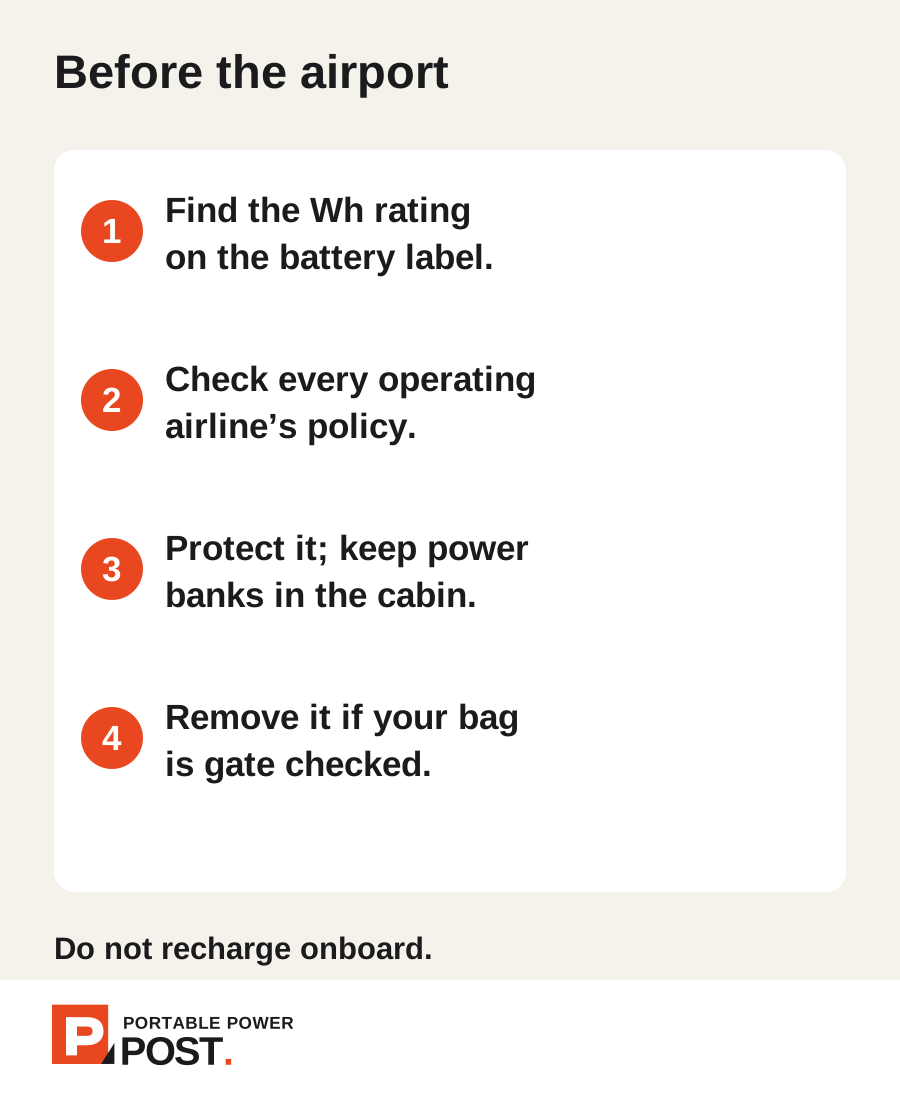
The capacity limit is in watt-hours (Wh), the battery’s energy rating. A station’s watts (W) describe output power and do not decide its flight allowance. A 200 W AC socket does not make a 128 Wh battery fit under a 100 Wh limit. Read the capacity label on the unit itself and its exact regional documentation. If only voltage and amp-hours are shown, calculate V × Ah = Wh; with milliamp-hours, V × mAh ÷ 1,000 = Wh. Use the battery’s rated voltage, not its AC outlet voltage. If the rating cannot be established, do not assume airport staff will accept it.
What each capacity band means
| Battery rating | Passenger decision for a station used as a charging source |
|---|---|
| 100 Wh or less | Potentially carryable in the cabin, subject to the operating airline’s policy, quantity and baggage limits. Confirm how the airline treats an AC-equipped station. |
| Over 100 Wh to 160 Wh | UK CAA rules require operator approval for a power bank in this band. That is a request, not a right to board. Some airlines set a 100 Wh cap on power banks. Get approval for the exact unit and each operating carrier before relying on it. |
| Over 160 Wh | Prohibited in passenger baggage, both cabin and hold. Moving it to a suitcase does not solve the problem. Transport as regulated dangerous-goods cargo is a separate process, not an ordinary baggage option. |
The name “power station” is not a regulatory exemption. Because it can charge other devices, plan for the airline to assess it as a power bank unless the airline confirms otherwise for your exact model. A station’s LiFePO₄ chemistry does not erase its Wh rating or airline conditions.
A real 128 Wh example
The UK BLUETTI Elite 10 is listed with a 128 Wh battery and 200 W AC output. Its capacity falls in the approval band, despite its small size. The UK CAA allows an operator to approve power banks over 100 Wh through 160 Wh, but British Airways says power banks must not exceed 100 Wh and its 100–160 Wh battery approval form is not for power banks. Do not buy or pack an Elite 10 for a British Airways flight on the assumption that the CAA band guarantees acceptance. Ask your operating airline to classify and approve the exact unit before making plans. We have no airline approval for this model.
The BLUETTI Elite 30 V2 is 288 Wh. It sits above the 160 Wh passenger-baggage ceiling. Many useful camping and backup stations are larger still. If you need power at your destination, arrange a suitable unit there rather than putting an over-limit battery in checked luggage.
Pack an eligible unit for the cabin
For power banks, the UK CAA limits carriage to two per person, requires them in carry-on baggage and says they must be individually protected when not in use. Keep the unit and exposed contacts protected from damage and short circuits. If staff gate-check your cabin bag, remove the power bank and keep it with you. Do not carry a damaged, swollen or overheating battery.
Do not recharge a power bank on board. Check the airline’s policy before using one to charge another device during the flight; the CAA advises checking first and some carriers restrict use or stowage. Keep it accessible and follow crew instructions. A capacity allowance only addresses carriage; it does not promise permission to use an AC outlet in flight.
Ask the airline this exact question
Send the operating airline the model name, a photo of the battery Wh label, chemistry, whether it has an AC outlet and the number of other spare batteries or power banks you plan to carry. Ask: “Will you accept this exact portable power station as cabin baggage on every leg, and is advance approval required?” Save the reply with your booking. Check the same question for your return and any connecting carrier.
For choosing a station for ground use, start with watts versus watt-hours and the energy planner. Their runtime calculations do not change aviation carriage limits.