
You have a power station that runs your equipment, but it runs out too soon. Should you add its matching battery or buy a larger station? Add a battery when you need more stored energy and the existing station already supports the load. Choose a different station when the load exceeds its output, you need different ports, or the combined system is awkward to move and recharge.
More watt-hours do not mean more AC watts
Watt-hours (Wh) describe stored energy. Watts (W) describe how much power an appliance draws at a moment. A battery can extend running time without changing the station's inverter limit.
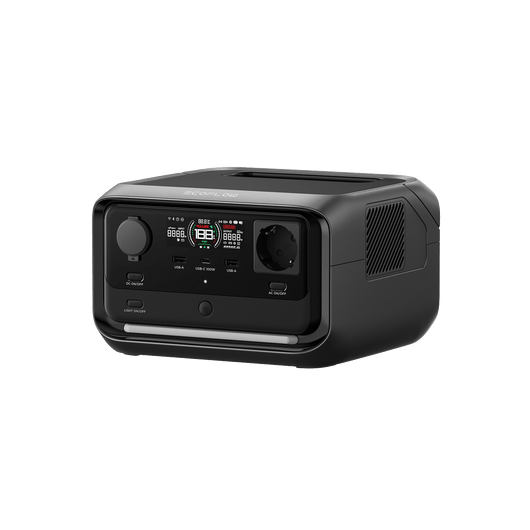
The UK EcoFlow RIVER 3 Plus shows the distinction. Its base unit has 286 Wh of nominal capacity and 600 W rated AC output. EcoFlow sells an EB300 extra battery with another 286 Wh, making the RIVER 3 Max package 572 Wh. The EB600 adds 572 Wh, making the RIVER 3 Max Plus package 858 Wh. These are RIVER 3 Plus systems with different batteries, not three unrelated base stations. The listed rated AC output remains 600 W across the series.
At a hypothetical steady 100 W AC load, 286 ÷ 100 = 2.86 hours, 572 ÷ 100 = 5.72 hours and 858 ÷ 100 = 8.58 hours. These are upper-bound arithmetic illustrations, not expected runtimes: AC conversion, standby use and the battery's usable energy reduce real running time. A device needing more than the base unit's rated AC output does not become suitable just because the battery is bigger. EcoFlow advertises X-Boost separately; do not treat its 1,200 W figure as a higher 600 W rated output or universal appliance compatibility.
Check what the extra battery can do by itself
An expansion battery is not automatically another complete power station. The RIVER 3 Plus EB300 and EB600 have a USB-C port rated up to 140 W for charging or output when used independently. They do not provide the base station's AC sockets on their own. That distinction matters if you want one person to take a laptop charger away from the main setup: USB-C may help, but a mains-only appliance still needs the station. Check the exact pack's outputs rather than assuming every expansion battery behaves alike.
Compare the complete job
Write down the appliance's running watts, any start-up demand, the hours you need and your available recharge window. If the existing station handles the load, compare its compatible battery package with a larger standalone station using the same energy requirement. Count both units' weight and dimensions, the connection method, charging accessories and the sockets you actually need. If you want two independent AC supplies in different places, price two stations as a separate option.
For the RIVER 3 Plus example, confirm whether the listing is the base station, an EB300 or EB600 alone, or a Max/Max Plus bundle. The name of a bundle is not proof that a second AC inverter is included. Our base-unit and bundle guide explains how to keep those offers separate. If the deciding question is running time, use the watts and watt-hours guide to make a load budget before comparing nominal Wh.
Do not buy a pack on capacity alone. Check the manufacturer's compatibility list for the exact base and battery, including any region-specific restriction, and confirm what is actually supplied. Then compare the complete price for your location on the same date. A price divided by nominal Wh cannot tell you usable AC energy or whether the package solves your particular load.